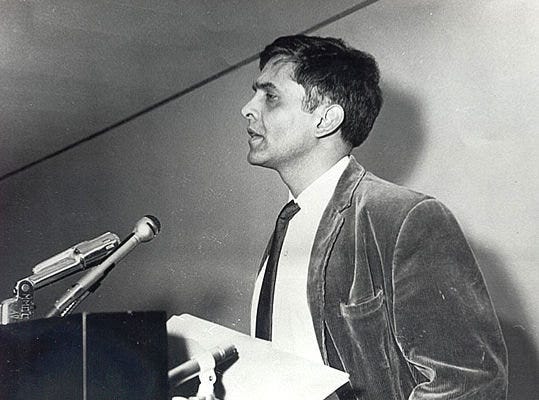
Eqbal Ahmad (1933-1990)

Born in 1933 in Gaya district of Bihar, Eqbal Ahmad was one of the foremost anticolonial intellectuals of the 20th century. The aftermath of partition violence forced Ahmad to migrate to Pakistan. During this period, he also witnessed the murder of his father over a land dispute. The memory of partition and dispossession stayed with him as he went on to become a staunch critic of Western imperialism. It was perhaps also this experience which would generate in him an empathy for the oppressed and marginalised, whether in Europe, America, Bosnia, Chechnya, South Lebanon, Vietnam, Iraq or the Indian sub-continent. In a review of The Selected Writings of Eqbal Ahmad, Stuart Schaar writes, ‘Eqbal Ahmad often said that he was a Palestinian. Despite his privileged position as professor, this Pakistani- who lived most of his adult life as an exile in the United States- intuitively understood the dilemmas faced by Palestinians: they suffered colonization at the very moment that the rest of the colonial world found liberation, making the pain of conquest and expulsion ever more repugnant.’ The Palestinian critic Edward W. Said claimed him as one of the two most important influences on his intellectual development. In the context of Israel-Palestinian conflict, Ahmad advocated for ‘a militant non-violent movement.’ He argued that Israel’s fundamental contradiction was that it was founded as a symbol of the suffering of humanity…at the expense of another people who were innocent of guilt. It’s this contradiction that he wanted to expose for the world at large
.